
ot long ago, computer technology mainly helped people look things up faster.
Now, generative artificial intelligence can write a paragraph, generate an image, or sketch out an idea in seconds, changing what it means to do the thinking ourselves.
Artificial intelligence has existed since the 1950s, but generative artificial intelligence entered everyday life much more recently. Here, “AI” refers to generative AI.
At the celebration of December graduates, President James Troha shared a list of the top 10 skills employers seek in college graduates and AI literacy made the cut for the first time. At Juniata, that shift is already influencing classrooms, student research, and campus policy.
“AI is everywhere, and it’s not new. What is new is how accessible it has become,” said Misty Andrade, associate vice president and chief information officer at Juniata. “It’s built into social media, the tools we use, and the websites we log into every day.”
Most of today’s generative AI tools are powered by large language models, or LLMs — systems trained on vast amounts of text to recognize patterns in language and generate responses that resemble human writing, alongside related models that create images and other visual content from text prompts.
AI: What It Is and How It Works
AI helps computers do things that usually require human thinking – recognizing patterns, making choices, or creating content.
Types of AI
Rule-Based AI
- Follows set instructions
- Example: calculator, simple chatbot
Predictive AI
- Uses past data to guess what comes next
- Example: Netflix or Spotify recommendations
Generative AI
- Creates new content: text, images, music, code
- Example: ChatGPT, AI image generators
Fun Fact
- Most AI today is narrow AI – built to do one job really well
- AI that thinks like a human is still science fiction
Exploring the opportunities and challenges of AI has been the charge of the College’s institutional AI Task Force, co-chaired by Andrade and Provost Lauren Bowen, with members representing a broad cross-section of disciplines from academic departments and administrative sectors.
“AI is everywhere, and it’s not new. What is new is how accessible it has become. It’s built into social media, the tools we use, and the websites we log into every day.”Misty Andrade, Associate Vice President and Chief Information Officer
The task force has multiple workstreams taking a comprehensive look at the implications of generative AI for not only the classroom experience but for how all of us work and how we gather, share, and evaluate information. Related, Juniata is participating in the Council of Independent Colleges’ AI Ready Initiative, a College-wide project providing participants with the opportunities to build and evaluate AI tools while also shaping campus policy and practice.
Territa Poole, associate professor of psychology and director of the SoTL (Scholarship of Teaching and Learning) Center, leads Juniata’s team, a second initiative sponsored by the American Association of Colleges and Universities (AAC&U) Institute which focused on AI in the teaching and learning environment. Team members include Bowen; Robb Conrad Lauzon, assistant professor of communication; Shuang Quan, assistant professor of education; and Thomas McClain ’94, assistant director of instructional technology.
“The goal of the AAC&U Institute is to help institutions decide how they want to foster student literacy with regard to AI. This work includes articulating and assessing learning outcomes, exploring the resources and tools we need to provide to instructors and students, and thinking through policies,” Bowen said.
“Understanding the implications of AI tools means recognizing they are resources, not replacements for imagination, independent thinking, or judgment.”Lauren Bowen, Provost and Professor of Politics
Since his time at Rensselaer Polytechnic Institute, Lauzon has been experimenting with various platforms to explore both strengths and weaknesses of AI technology. Most importantly, he considers the ramifications within the classroom and the field of communication.
“In managing strategic communication, there’s value in being able to dig deep and scan wide for resources. As a professor, I try to show my students how powerful it is in that sense,” Lauzon said.
AI’s propensity for hallucination means human oversight is crucial. Andrade described these incidents as “answers that sound completely correct but aren’t when you take a closer look.” In one AI encounter, she asked the program for a relatable equivalent to 6,983 pounds of recyclables. Its response was “one baby grand piano, or almost the weight of one adult elephant’s heart.”
When that answer didn’t seem quite right, she asked for sources and the answer changed to two baby grand pianos… or 151 elephant hearts.
“In looking at the answers AI gave, I started doing my own research,” she recounted. “We need to be careful not to blindly trust everything that it returns.”
The goal of the task force, particularly when it comes to AI usage in a classroom or research setting, is not to prohibit AI, but to foster literacy, intentionality, and ethical practices. While encouraging faculty to set explicit classroom expectations, students and instructors alike are discovering how AI can enhance learning, research, and administrative efficiency – without replacing critical thinking, creativity, or human connection.
In Bowen’s view, literacy begins with perspective: “Understanding the implications of AI tools means recognizing they are resources, not replacements for imagination, independent thinking, or judgment. They help distill information into manageable bits, but students still need to exercise discernment.” She added, “There’s a healthy skepticism among a critical mass of students, which is important. They understand the need to engage with AI responsibly rather than randomly.”
That skepticism has resulted in the formation of H.U.M.A.N. (Holding Unethical Machine usage Accountable Now), a student club on campus.

AI can generate and assist, but meaning is created through human connection, critical thinking, and shared experience.
“H.U.M.A.N. exists because we want our peers to know that nothing is more important than your ability to think for yourself,” said Zachary Riggall ’29, the group’s founder. “I think it's easy to forget the fundamentals nowadays — being kind, having your own opinions, trying to do your best in your studies. H.U.M.A.N. hopes to encourage the student body to really consider what they are giving up in the name of convenience or innovation.”
Members of H.U.M.A.N. are far from Luddites. Rather than eschewing the emerging technology, they are advocating for careful integration prioritizing individual learning and comprehension.
“The truth is, generative AI is here, and it isn’t going anywhere anytime soon. It would be totally unreasonable to expect a data scientist to never use AI for research, just as much as it would be unreasonable to ask a math student to never use a calculator,” Riggall clarified. “H.U.M.A.N. club wants our peers to ask the question, ‘Do I really need a calculator for this problem?’”
“H.U.M.A.N. exists because we want our peers to know that nothing is more important than your ability to think for yourself”Zachary Riggall ’29
In a presentation to members of the Student Government Association, Poole mentioned many students are interested in how the Task Force is approaching AI work at Juniata.
A core concern is AI’s impact on the mechanics of learning. Lauzon warned that sole reliance on technology over thought process and lack of experience and expertise are a dangerous prospect.
“I worry that students are foregoing important cultivation of memory and relational knowledge. If they rely too much on AI, they may lose the ability to synthesize information from their own understanding,” he said. “Rapid adoption without cultivating knowledge could erode the wisdom our society relies on.”
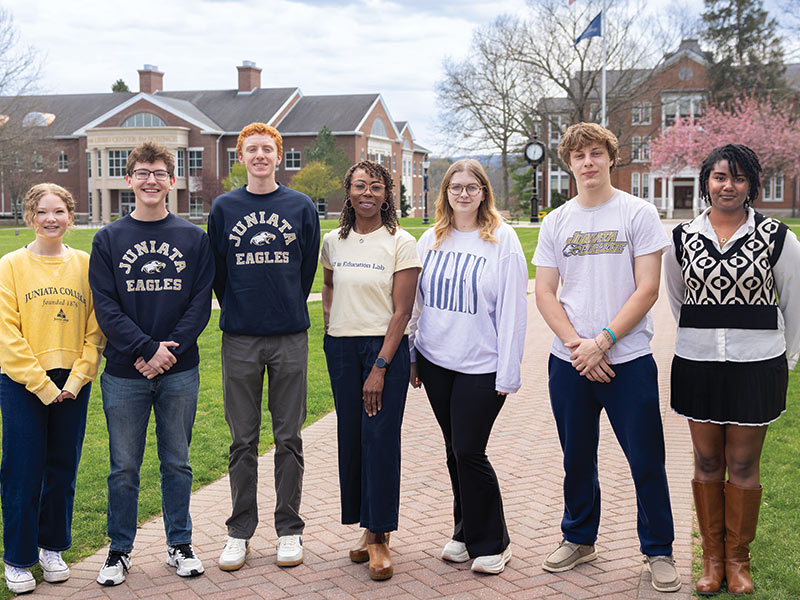
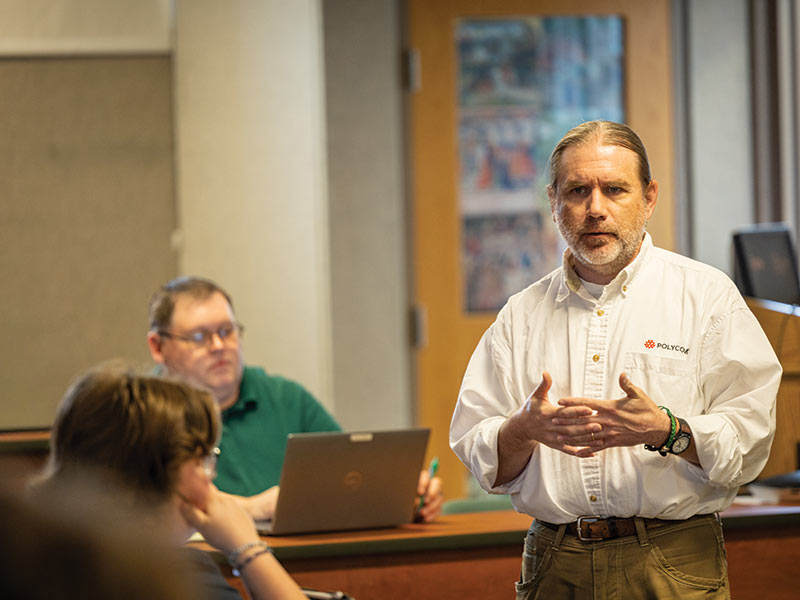
Above: Led by faculty advisor Territa Poole (center), members of H.U.M.A.N. (Holding Unethical Machine usage Accountable Now), from the left, Abbey Landahl ’29, Zachary Riggall ’29, Noah Rosner ’29, Elle Barnes ’29, Finn Anderson ’29, and Mariam Sesay ’29, advocate for careful integration of AI, prioritizing individual learning and comprehension.
Innovation, along with investigation into AI’s potential and pitfalls, is taking place across all sectors of the College’s campus. Improved access to existing information could help those on campus as well as prospective students get answers to questions quickly. Many of the tools Juniata’s offices already use have AI capabilities built into them; it’s a matter of mindful implementation.
As campus administrative offices explore implementation of AI processes, Andrade emphasized that any AI use must comply with federal privacy laws and protect student, faculty, and staff data.
Since the first class of students arrived 150 years ago, Juniata has witnessed technological advances unimaginable by its founders. The advent of the telephone, automobile, radio, airplane, television, computer, and the internet brought questions of the impact on human relationships. Through it all, Juniata has remained committed to human-centered education and preparing students to lead thoughtfully and ethically into whatever the future holds. To that end, each academic department will articulate an AI literacy outcome this year, recognizing that healthy disciplinary variation will shape what that outcome looks like in practice.
“AI cannot create meaning. That’s the human part, and that’s really what we’re about at Juniata — relationships and meaning and value and being good citizens in the world.”Territa Poole, Associate Professor of Psychology and Director of the SoTL Center
On a campus renowned for faculty-student partnership, members of Juniata’s AI Task Force see implementing these tools as a way to accelerate information processing and research, synthesize data, and allow more time for problem-solving and creative thought.
In Poole’s view, the future of AI at Juniata depends less on what the technology can produce than on what it can never become.
“AI cannot create meaning. That’s the human part, and that’s really what we’re about at Juniata — relationships and meaning and value and being good citizens in the world,” she explained. “AI can make something, it can record something, but it doesn’t have the capacity to create meaning. The value of a liberal arts education resides in these human-to-human encounters. AI cannot reproduce these encounters. This is where meaning is made.”
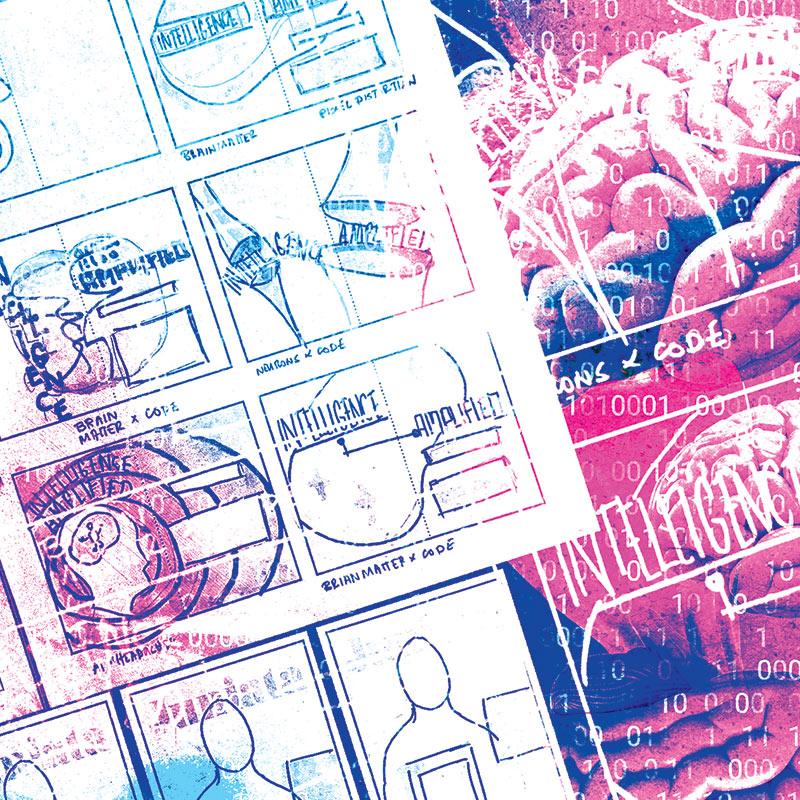
Above: From rough sketches to visual concepts, Tracy Kretz uses AI to augment the creative process while ensuring human judgment and accountability drive the final work.
First Person
When AI Meets Creativity
by April Feagley g’23
AI-generated images are everywhere, raising a question that goes beyond what we can create to what and how we should.
Tracy Kretz, executive director of strategic marketing and brand design at Juniata, sees AI technology as a powerful tool for ideation and prototyping — a way to turn rough sketches into visual concepts without letting the machine replace human creativity.
Drawing on broad experience leading design work for global companies, she recalls that storyboarding once involved hours of sourcing and customizing images to create a shared set of visuals to which everyone can point to, react to, and refine together.
“The most useful place for AI is during the ideation phase,” she explained. “Now, you can feed a script into the tool with art direction prompts to generate something close to what you are imagining.”
Human judgment and guidance are essential.
“What makes me uncomfortable is when people use it as a shortcut, instead of contributing their own creativity,” Kretz added.
“When work is published or monetized, that’s where the ethical questions start. Even with careful prompting and reference images, I can’t fully verify what influenced the output or feel the certainty I would with licensed stock or commissioned work.”
Even with signals that an image is AI-generated, there is rarely a source-by-source trail of influences. That is where critical thinking, especially in a liberal arts context, matters. “You still have to ask: Is this right? Is this ethical? Is this true?” she said. “AI can generate options, but it can’t generate accountability. That part stays with us.”
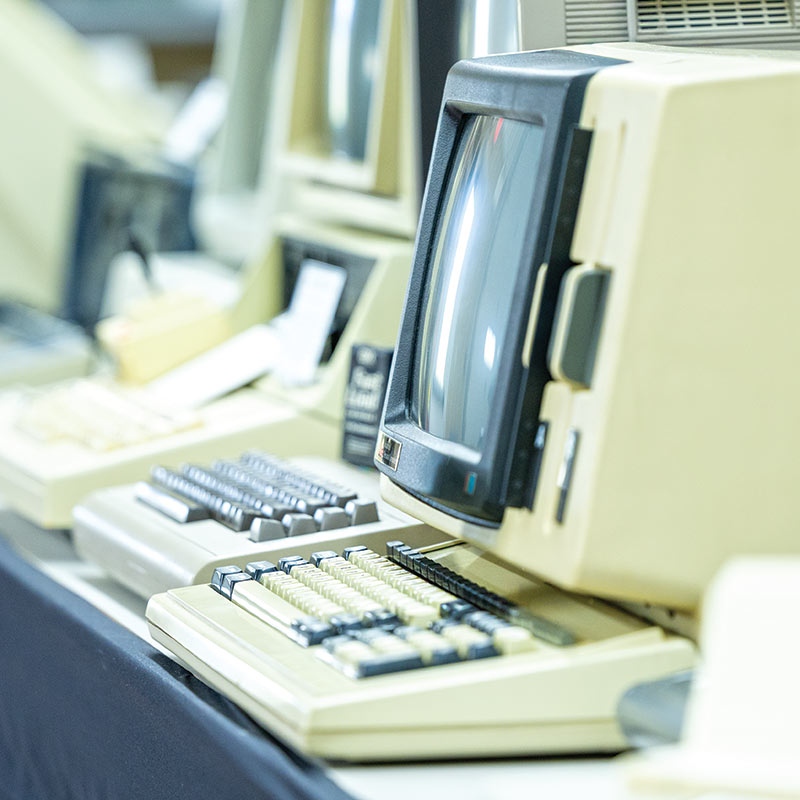
Above: A display of vintage computers at Isett Heritage Museum showcases models from the late 1970s to the early 2000s.
Object
Blazing the Digital Trail
by April Feagley g’23
Like their technological predecessor, the calculator, personal computers began as expensive luxuries that initially changed little in daily life.
B. Edwin Blaisdell, professor of chemistry and self-taught computer expert, prompted and led Juniata College’s entry into the computer age. In 1963, when the College purchased its first computer, an IBM 1620, he became its caretaker.
“The sciences and mathematics departments were using computers in Brumbaugh Science Center (now, Brumbaugh Academic Center),” said Jim Lakso, professor emeritus and provost from 1997–2013. “You would use a programming language like Fortran or Cobol to write a program which you typed up on computer cards. You submitted the cards to the computer operator who put you in the queue. If you did everything right, you might be able to get your results in a day. If you made a programming error or a typing error, you had to start over."
Throughout the 1960s and 1970s, technology continued to evolve, but early models were “clunky and difficult to use,” Lakso recalled. At one point, departments even shared a single computer mounted on a rolling cart, transporting it from office to office.
Faculty devoted substantial time to learning the latest developments, then applied that knowledge to design curricula that prepared students for a world increasingly shaped by computers.
By the late 1980s, computer labs had been established in every academic building, giving students access to transformative technology. That same spirit of innovation now connects Juniata students to a digital world Blaisdell could only imagine, continuing the College’s tradition of preparing students for life at the forefront of technology.

Above: The image of the data center was created using Adobe Firefly and Adobe Photoshop, guided by human-made sketches, textures, color palettes, and human-drafted prompts. Click here to learn more about the process behind it.
Alumni Insight
Balancing Innovation with Sustainability
by April Feagley g’23
AI is everywhere in daily life, but its environmental costs are often hidden.
Celina (Isenberg) Seftas ’07, Juniata’s director of sustainability, emphasizes that the data centers powering AI place heavy demands on electricity and water. “Power companies are having to build additional capacity to accommodate data centers, which increases costs for consumers,” she explained. These systems contribute to peak load stress on the hottest and coldest days, requiring careful management to maintain grid stability.
AI’s carbon footprint — the greenhouse gases emitted from its operation — is substantial. “The amount of emissions from a single AI query varies based on the model used and the complexity of the prompt,” Seftas noted.
In addition, data centers have a substantial land footprint, leading to concerns from rural and suburban communities about noise, construction traffic, and loss of farmland.
Water usage is another concern. Data centers draw heavily from local resources. “Even in Pennsylvania, which has abundant water, we must plan responsibly given competing demands during periods of drought,” she said.
Still, AI is not inherently harmful. “Using AI for frivolous things seems like a waste of resources,” Seftas said, “but there are great applications in medical research and environmental sectors, where it can streamline systems, reduce waste, and direct resources efficiently.” Responsible AI would prioritize renewable energy and purposeful use rather than being embedded in every routine task.
As institutions like Juniata explore AI, balancing innovation with environmental stewardship is critical. With careful planning, AI can serve society while protecting the planet’s resources.
Closer Look
Thinking About AI, One Question at a Time
“Computers are useless. They can only give you answers,” Pablo Picasso said in 1968. But what if the real question about AI isn’t the answers it gives, but the endless line of inquiry it sparks? How does generative AI — or the more advanced agentic AI — “think”? And is think even the right word?
Tom McClain ’94, assistant director of instructional technology, describes it as an algorithmic, iterative process. “AI is a computer’s ability to take pre-existing work, look at the body of knowledge, and provide answers back. The generative part comes in because, as it replies, it can fold that information back into itself, iterate, and improve based on the quality of the responses,” he said.
Computer-generated answers are built on human-generated data. McClain warns, “If you feed bad information in, you get bad information out. Be mindful that at some point, that data was keyed in by a human and bias or errors can be introduced into the mix.”
At its core, AI converts questions or tasks into code, converts the text into vector data which can be used to analyze “closeness” or probability, and calculates the most probable responses. “That’s how AI currently ‘thinks,’” McClain said. “It’s about the probability of the responses based on the words, not on what we know is truth. That’s where hallucinations occur — if it doesn’t have context it gives the most probable response.”
Even mistakes, however, reveal how AI is designed: it’s built to respond agreeably and promptly. “It’s similar to positive customer service experiences,” McClain explained. “AI is going for those dopamine hits. It won’t be grumpy or scold you. It wants to be your best buddy. It will provide a response, guide the conversation, and keep you coming back.”
In the end, AI may only give answers, but its true power lies in how it sparks new questions, turning human curiosity into a dialogue.
Digital Exclusive: Behind the Image
How the “Data Center” was made
By Tracy Kretz, Executive Director of Strategic Marketing and Brand Design
The Assignment
Every issue of Juniata magazine includes in-house editorial illustrations to amplify the stories we tell. For this issue, one of our feature articles explores how Juniata is approaching generative AI — thoughtfully, ethically, and with human judgment at the center.
To illustrate a sidebar about the environmental impact of AI data centers, I created an image using generative AI tools.
This task gave me pause.
Using a generative AI tool in place of my own hand felt like a real trade-off — not because I couldn’t do it, but because I can. Creating editorial illustration is a part of this role I value, and layering in the subject matter of this particular story made the decision harder, not easier. The exploration was useful for stretching my prompting vocabulary and sharpening my art-direction instincts. But there was a deliberate decision to make here, and I didn’t want to make it casually.
I chose to move forward because the transparency it required felt like the more instructive outcome — for me and for anyone watching how this institution navigates AI. That decision came with a responsibility to document every step of the process honestly.
The Human Work First
Before I opened a single AI application, I started with sketches.
My tool of choice is a black Paper Mate® Flair pen — there is something about it that slows my thinking in the right way, allowing me to focus on the shape of my ideas rather than the surface details. On this occasion, however, I was working from home and wanted to move quickly, so I sketched directly on my iPad Pro using an Apple Pencil Pro and Apple’s Freeform application. The result was looser than my usual marker process, but the intent was the same.
I drew the composition by hand – four large industrial buildings arranged in a grid, a conifer tree line to the upper left, rolling hills in the background, a retention pond, sound disturbance lines radiating outward from the buildings, and a water runoff channel along the perimeter. My sketch didn’t need to be perfect, just good enough to communicate my idea. The sketch established the isometric perspective, the scale relationship between the facility and the natural landscape, and the environmental storytelling I wanted the image to carry.
Next, I pulled the color palette established for the Intelligence Amplified article. That visual language was already defined by humans – vivid purple, hot pink, magenta, acid yellow-green, and white, with gritty and distressed textures throughout. I built a gritty, blended-color reference image using Adobe Photoshop to use as a direct style input. The colors needed to feel electric and editorial, not naturalistic.
The sketch and the palette were my two anchors before any AI was involved.
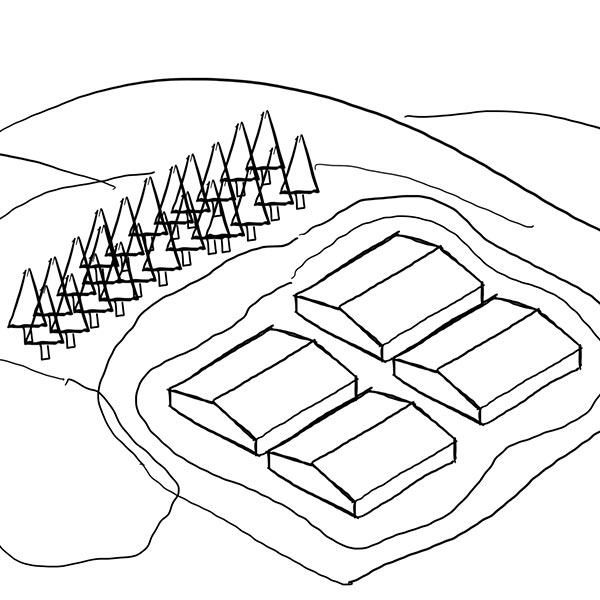

Reference sketch composition and reference style (using Adobe Stock, Photoshop layering effects, and digital painting)
The Tools
Adobe Firefly was used to generate the base illustration. Firefly is trained on Adobe Stock imagery and licensed content – not open internet scraping. That distinction matters to me. I uploaded my hand-drawn sketch as a composition reference and my color palette as a style reference. I then wrote a text prompt to guide the image's content, mood, and details.
What Firefly gave me was a strong starting point. Not a finished image.
Adobe Photoshop is where the real art direction happens. The feature article already had an established visual language – specific color effects, texture treatments, and digital painting techniques applied consistently across every other image in the layout. Firefly could not replicate that system on its own, and asking it to try would have taken far longer than doing it directly.
I brought the Firefly output into Photoshop and treated it the same way I treated every other image in the story. I applied the same effects, overlays, and digital painting techniques to ensure visual consistency throughout the feature. That process required judgment, craft, and a clear understanding of what the layout needed. It is also where the image stopped feeling like an AI output and began to feel like part of the magazine.
After nine iterations and re‑prompting, the side-by-side comparison below shows where I started with Firefly and where I finished in Photoshop. The difference isn’t just technical—it’s the result of human thinking, refining, and intentional tinkering.

Firefly
Photoshop
The Prompt Process
Writing prompts for AI image generation is an art direction skill. It requires the same clarity of thinking and communication as briefing a photographer or illustrator – except the language must be precise enough for a machine to interpret.
Where I started:
An isometric three-quarter aerial view of a large-scale AI data center complex situated in an open rural landscape. The facility contains exactly four large, wide, low-profile industrial buildings arranged in a 2x2 grid pattern centered in the composition. The architecture is modern and utilitarian – no smokestacks, no steam, no signage. A dense coniferous tree line runs along the upper-left edge of the facility, visually dwarfed by the complex's scale. Rolling hills extend into the background. A retention pond and water runoff channel wrap organically around the perimeter of the facility. The surrounding land shows cleared and disrupted earth. Sound pollution is suggested through subtle low-frequency wave lines radiating outward from the buildings. Lighting is dynamic and directional with sharp, dramatic shadows. Vibrant and electric – not golden hour. Color palette pulls directly from the style reference: vivid purple, hot pink, magenta, acid yellow-green, and white. Rich and saturated. No human figures. No text. Architectural illustration quality. Editorial magazine aesthetic.
My first prompt was too long. Adobe Firefly has a 1,000-character limit, and my initial draft exceeded it by roughly 350 characters.
To reduce it, I turned to Claude AI, sharing my full prompt and asking it to trim the language while preserving the essential art direction. That collaboration was efficient and precise – Claude understood the visual intent behind the language and knew what to protect and what to cut.
The refined prompt came in at approximately 900 characters:
Isometric three-quarter aerial view of an AI data center complex in an open rural landscape. Four large, wide, low-profile industrial buildings in a 2x2 grid, centered in composition. Modern utilitarian architecture – no smokestacks, no steam, no signage. Dense conifer tree line upper left, dwarfed by facility scale. Rolling hills in the background. Retention pond and water runoff channel wrap around the perimeter. Cleared and disrupted the earth surrounding the facility. Subtle low-frequency wave lines radiate from buildings, suggesting sound pollution. Lighting is dynamic and directional with sharp, dramatic shadows. Vibrant and electric – not golden hour. Color palette: vivid purple, hot pink, magenta, acid yellow-green, and white. Rich and saturated. No human figures. No text. Architectural illustration quality. Editorial magazine aesthetic.
Seeing the two prompts side by side tells its own story. The meaning is identical. The first version reads like a creative brief. The second reads like a directive. Both required human thinking and review.
What I learned: the gap between what you imagine and what AI generates is real. The first output is rarely the final output. Prompting is iterative. Every adjustment teaches you something about how the tool interprets language, and about how clearly you understand your own vision.
The Editorial Decision
I want to be direct about why I am sharing this process publicly.
The article this image supports argues that Juniata’s approach to AI is human-guided, values-based, and transparent. It would be inconsistent – and frankly dishonest – to place an AI-generated image in that article without acknowledging it.
The QR code and this digital exclusive exist because transparency is not a footnote.
There is a broader conversation happening in publishing, education, and design about what it means to use AI responsibly. I do not think the answer is to avoid it entirely. I also do not think the answer is to use it invisibly. The answer – at least the one I am working toward – is to use it intentionally, document it honestly, and keep the human judgment visible at every step.
That is what Juniata is asking its students, faculty, and staff to do. It felt right to model it here.
The Result
The final illustration depicts an AI data center complex in a rural landscape – large, utilitarian buildings surrounded by retention ponds, disturbed earth, and a coniferous tree line that feels dwarfed by the facility's scale. The color palette is vivid and editorial. The mood is beautiful and quietly unsettling.
That tension was intentional. AI infrastructure is real, it is growing, and it has environmental consequences that are not always visible to the people using the tools. The image is meant to make that visible – even briefly, even in a magazine sidebar.
What this process taught me most is that AI does not replace creative thinking. It responds to it. The quality of the output is directly proportional to the clarity of the human direction behind it.
That feels like a Juniata lesson.