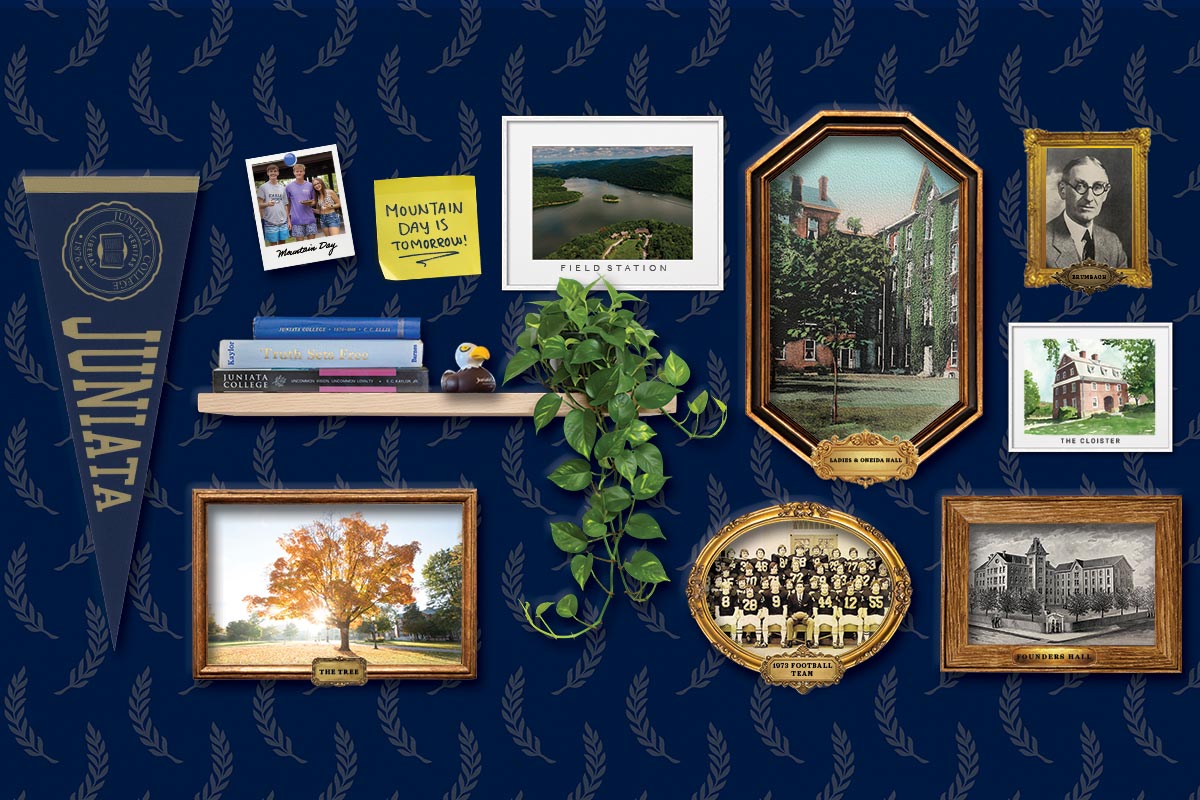
“President Troha, please don't come here expecting to change Juniata. Let Juniata change you.”Seth Ruggiero ’14
hen President James Troha reflects on his 12 years as president of Juniata College, his first memory is somewhat unorthodox. It’s of sitting in his Ohio living room, before the start of his presidency and prior to moving to Central Pennsylvania, listening online to Juniata’s oldest academic tradition: the Bailey Oratorical.
The prompt for the 2012 competition? What advice would you give to our new president? And one response in particular has guided Troha’s presidency ever since.
“We had a lot of students share a lot of different ideas. But there was that one comment that really, really made me think,” he recalls. “And the longer I’m in this role, the more important it becomes to me.”
That small piece of advice — “Let Juniata change you” — was less a suggestion than a roadmap that thousands of alumni, faculty, staff, and students have come to know: the greatest experiences come not from imposing change on this close-knit campus in the heart of Pennsylvania, but from listening, adapting, and allowing the character of the community to shape their path forward.
To tell the story of Juniata’s sesquicentennial anniversary, you need to begin with the last 25 years, a period that has tested that advice in unprecedented ways. The formative years of Juniata’s students, a generation known as “digital natives,” were carved after 9/11 and during the Great Recession. A global pandemic transformed daily life and learning. Social media, smartphones, and now artificial intelligence have forever altered how students connect, collaborate, and consume knowledge. Rising tuition and student debt are routinely reported in headlines and add newer practical pressures.
In almost every way, today’s students are defined by their resiliency.
Jill Keeney, Charles A. Dana Professor of Biology, understands the complex lives students bring with them to campus. “Students have a much harder job now — they have to manage information flow, stay off social media distractions. For too many, they don’t have the luxury to just focus on being a student. Many of them are running back home on weekends, taking care of a grandparent, working extra hours.” She takes a second to reflect. “I’ve seen that, and that is so, so difficult.”
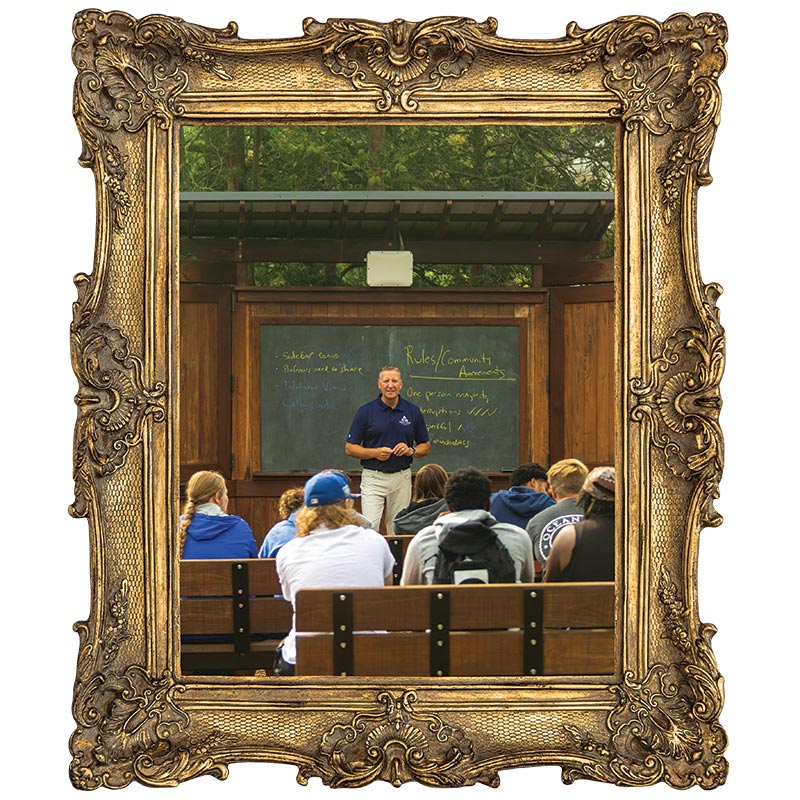
President James Troha taught a First Year Foundations class during the Fall 2025 semester along with teaching assistant Maggie Eckroat ’26.
Recognizing those challenges, she says, allows faculty to guide students more effectively. And yet, Juniata’s students are remarkably fluent in adaptability, unafraid to ask hard questions. It’s become part of their generational DNA and, in so many ways, mirrors the identity of a liberal arts college that has leaned into societal change without losing its essence.
“Juniata has been forward looking, but it is grounded in a foundation and a tradition,” says Provost Lauren Bowen. “It’s not just chasing the new shiny thing. It is building on the strengths we have, but knowing that we have to be nimble and adaptive.”
It’s why students are so well equipped to not just handle change, but help lead it. The general education curriculum, she explains, was redesigned to emphasize how students engage with information rather than simply consume it.
“Knowledge isn’t something to be consumed in the twenty-first century,” Bowen explains. “Knowledge is ubiquitous with the web. It’s how you evaluate knowledge, how you analyze information, how you ask good questions — that really matters.”
And it’s why the College’s Program of Emphasis, groundbreaking when it was introduced nearly 50 years ago, remains a point of distinction for Juniata. The unique program was, and is, tailored to meet personal interests and the career aspirations of students. Former President Thomas Kepple still believes the POE creates cross-departmental collaboration unlike nearly any other college. “Because students are working across departments to build their own programs, faculty have to work together. They really know each other better here than at most institutions, and that benefits the students in countless ways.”
Bowen loves pointing to examples of cross-disciplinary work: a historian and a plant biologist traveling to Barbados, a geologist and an English professor studying in Iceland. “That has long been the magic of Juniata,” she says. “The faculty are experts, but they’re eager to learn from and work across fields with students. That’s why you have such strong mentoring, strong advising, and so many students publishing research as undergraduates.”
“Innovation doesn’t come at the expense of collaboration,” said Bowen.
That collaborative ethos has deep roots. Kepple recalls that when a trustee offered a large gift to establish an Information Technology program, it was faculty who evaluated and designed the program, integrating it into Juniata’s liberal arts framework. “Even if there’s a gift, that doesn’t necessarily mean there’ll be a program,” Kepple explains. “But at Juniata, the faculty embraced it. Within six to eight months, the program was in place. That doesn’t happen often in higher education.”
That academic pedigree has long been a staple for the College. So has its intimate connection to rural communities across the region. And yet, for years Juniata has extended its sense of community to include students from far beyond central Pennsylvania. Thousands of international students from across the globe have come to Huntingdon for its highly personalized experience. This liberal arts enclave offers a unique blend of research and learning in an environment that has always embraced them with open arms.
This year, more than 160 international students from 35 countries study alongside American students from rural towns and large cities, enriching classrooms and campus life with diverse perspectives. That cultural interplay has been at work for more than two generations of Juniatans. And it’s a hallmark of the college.
“Even here, we’ve always been a bit of a melting pot,” Troha says. “Our global reach — our international reputation — it’s really one of our core strengths. There’s already this spirit of inclusion and of respect, a willingness to listen and truly pay attention to the diversity of viewpoints that exist here.”
At the heart of it all is Huntingdon. The town of 7,000, the surrounding hills, and the local rhythm anchor students in a sense of place that is inseparable from campus life. Standing Stone Coffee Company celebrates its ties with the College, even offering a “Blue and Gold” blend. Boxer’s and OIP have been calling students and alumni back for what seems forever. Back on campus, the quad, Founders Hall, Statton Learning Commons, the observatory — they’re not just spaces, but stages for discovery and shared experience.
“There’s a culture here that ‘we are one’,” Troha says. “Students are part of this little community that is theirs for three or four years. And that’s pretty special.”
“Knowledge is ubiquitous with the web. It’s how you evaluate knowledge, how you analyze information, how you ask good questions — that really matters.”Lauren Bowen, Provost
Jim Tuten, Dr. Charles A. and Shirley R. Knox Professor of History, agrees. “The most striking thing — the gobsmacking thing — is the sense of trust at Juniata.” You can hear the earnestness in his voice, a common refrain of others interviewed for this story. They talk, almost in disbelief, of how students leave their laptops and phones in Statton, or toss their backpacks in the Ellis Hall lobby. “It’s kind of mindboggling. It just speaks of the absolute, intrinsic, unthought-about trust here, that people are going to respect my belongings. And that’s a sign of respect for me.”
That’s why Juniata’s story, 150 years in the making, has always been less about buildings and milestones than about its people — a tightly knit, fiercely authentic community, where everyone looks out for one another. That spirit of connectedness became even more prominent with the closure of 18th Street nearly 25 years ago, a decision that unified the quad. Flying frisbees have replaced cars as the biggest source of traffic.
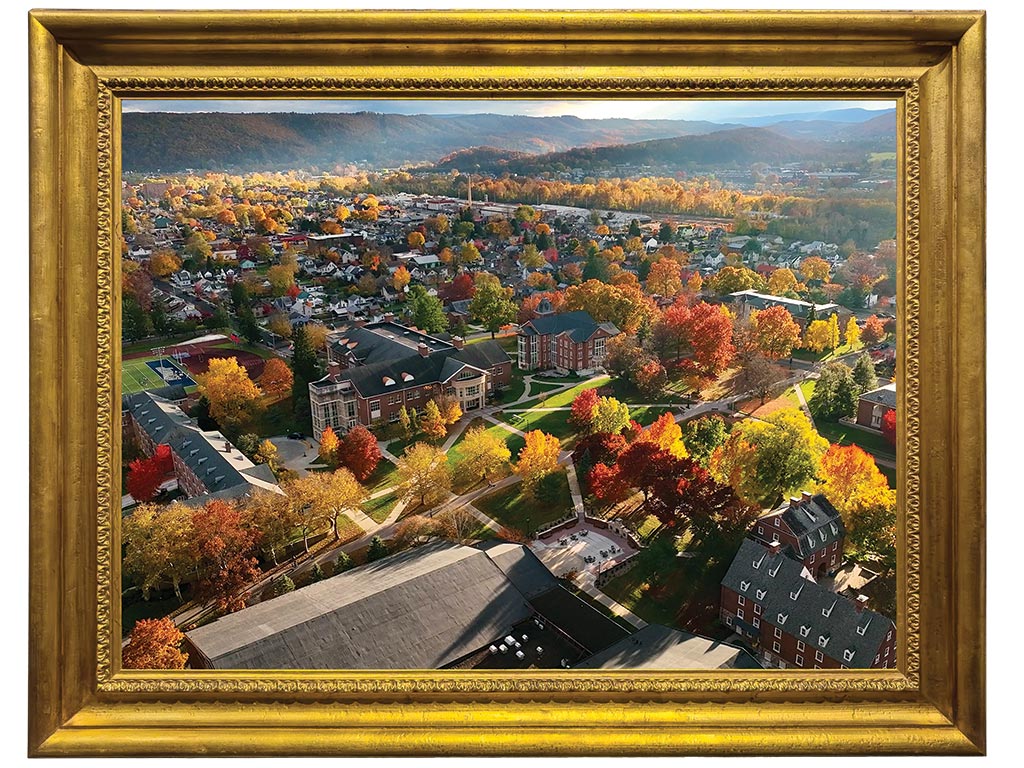
Juniata’s campus, nestled in the surrounding hills, integrates neatly with the surrounding community.
Mountain Day, announced without warning, sends the campus hiking, picnicking, and sharing the outdoors to-gether at nearby Raystown Lake. The Bailey Oratorical challenges students to step into the spotlight, articulate ideas with clarity and courage, and engage in intellectual discussion that leaves lasting impressions. Tenting season. Madrigal. Storming of the Arch. Lobsterfest. These traditions root students in something timeless.
These traditions have been exhaustively captured over the years, but Tuten and two senior students, Maddy Seipp ’26 and Finn Thornhill ’26, are gathering an oral history project for the 150th anniversary, weaving these moments into a mosaic of voices. More than 30 interviews have been conducted and another 20 or so are underway, but Tuten quickly noticed a com-mon thread connecting alumni, faculty, and staff experiences.
“Unequivocally, there’s this sense that we’ve been part of something special here. Former colleagues at other institutions say – they can articulate it – there was something indeed special about Juniata.”Dr. Jim Tuten, Charles A. and Shirley R. Knox Professor of History
“Unequivocally, there’s this sense that we’ve been part of something special here,” Tuten says. “Former colleagues at other institutions say — they can articulate it — there was something indeed special about Juniata.” In one of those interviews, former volleyball coach Larry Bock summed it up: “Juniata is a powerhouse community.”
Even during the pandemic, the College’s ethos shone. Faculty and students adapted to new protocols with care and attention for vulnerable community members. Bowen notes, “There was some moral imagination that went along with it. It wasn’t just reducing the pandemic to biology or economics. Faculty helped students think about how to weather tough times as a community and see to the other side of it.”
Keeney sees another point of distinction. “Our students are willing to engage. They’re not afraid to raise their hand, to stop me in the hallway, to ask why something works the way it does. They want to be part of the learning, not just recipients of it,” she explains. “They are engaged, they’re excited. It’s just why teaching here is so much fun.”
That eagerness to explore is nurtured from day one, and it extends beyond individual learning to interdisciplinary collaboration. Early in her career, Keeney helped develop student-faculty research programs that bridged the sciences, history, philosophy, psychology. “Our research became very interdisciplinary. That was hugely inspirational.” This commitment to integrated learning is celebrated annually at the Liberal Arts Symposium, where hundreds of students present their research. It remains the most popular academic event of the year.
This sesquicentennial year, the campus is marking the milestone with events that honor the past while looking forward. At the center of this effort is Lorri Panaia, director of events and new business development, as well as co-chair of Juniata’s 150th Committee with Bowen, whose planning brings the College’s sense of community to life. “We’re not just doing a single event,” she says. “This is about creating experiences that bring together alumni, students, faculty, and staff in ways that feel personal and memorable.” The celebrations officially began with a special convocation ceremony on Monday, August 25, 2025, the first day of classes, honoring both Juniata’s past and its future. That ceremony, along with Campusfest, kicked off a calendar of activities designed to engage the campus and the Huntingdon community.
Highlights include guest speakers, TEDx talks, art exhibits, concerts, and more, with a culminating event planned for April 2026, promising a full community celebration. Panaia draws energy from the students themselves. “That’s what makes planning these big moments so special, because you know they’ll embrace it with their whole heart. And that’s rare. You don’t always find that in other places.” Her approach reflects the same ethos that has long defined Juniata: fostering curiosity, collaboration, and pride in community.
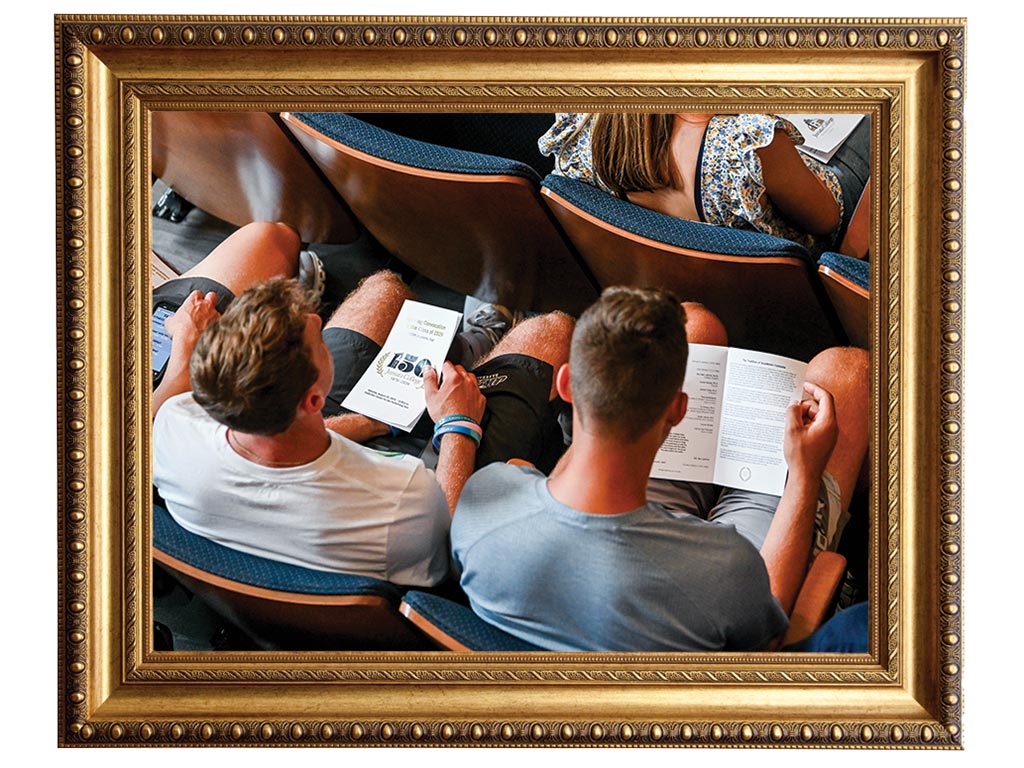
Students joined the celebration of Juniata’s 150th anniversary at the Opening Convocation held on the first day of classes in the fall.
Along with those three core values of Juniata, it’s often the fourth that captures the hearts of those on campus: the everyday acts of kindness. Panaia shares a gentle laugh as she talks about the faculty and staff and their volunteer “moving crews” for new colleagues, or the meal sign-ups for life events. Or how students walk around campus with their heads held high, rather than looking down at their smartphones. “It certainly makes it feel like a community, like everyone’s always looking out for each other,” she adds.
And that advice that Troha received, from nearly 330 miles away, before he stepped onto campus as its 13th president? It’s what he now tells new students and colleagues, too.
“The students who come to Juniata aren’t expecting everything to be handed to them. They come in and they say, ‘OK, what do you have to show me? What can I do to learn?’” he says. “Regardless of where you come from, you’re going to feel welcome here at Juniata and I think that’s been a defining part of our identity since we were founded in 1876.”
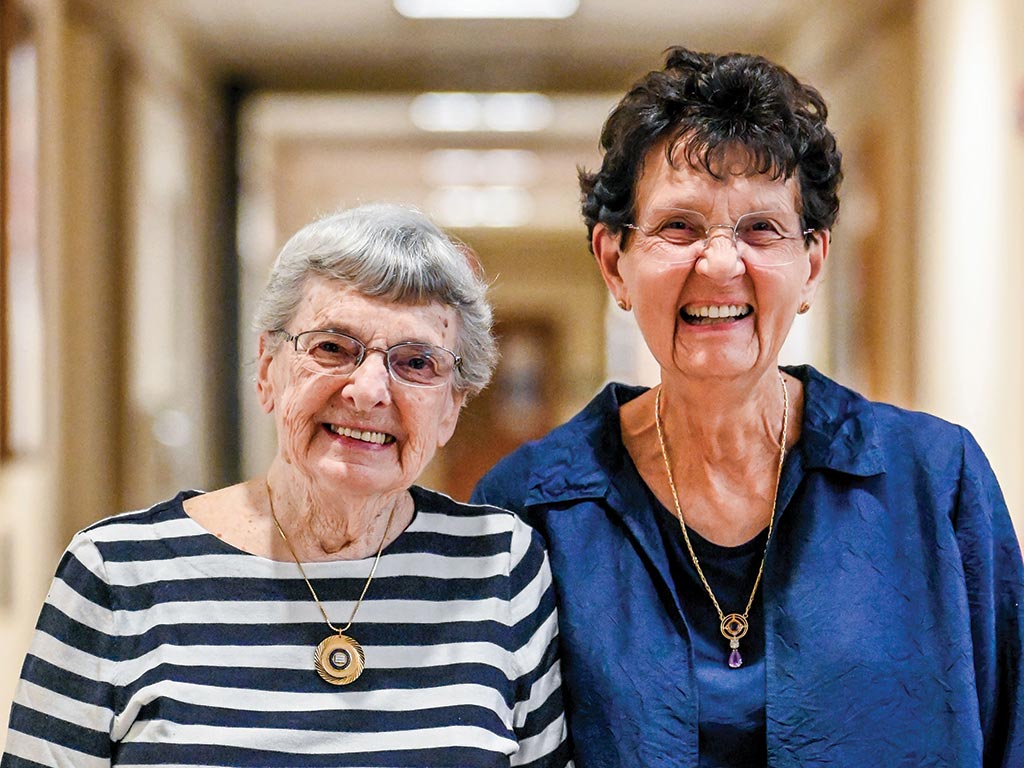
Above: Betty Ann Cherry (left) visited with Carol (Heaton) Pletcher ’66 prior to Juniata's 147th Commencement in May 2025.
Alumni Insight
Of Square Dances and Silent Marches
History through Betty Ann Cherry’s eyes: Family, teaching, tradition
By Tom Yencho
History may not always repeat itself, but at Juniata, it certainly runs in the family. Betty Ann Cherry laughs when she tells it: “Three of my four grandparents were Juniata grads in the 1880s and ’90s. My parents in the ’20s. My husband in the ’50s. My daughter for a summer in the ’80s. My grandson in 2021. That’s five generations.” And then, with a twinkle, she adds, “And my grandmother’s uncles were among the folks who put up money to found the place in 1876.”
So Betty Ann didn’t just “grow up” on campus — her family home became the president’s house when her father, Calvert Ellis, Class of 1923, took the helm. She remembers square dances in the old gym and performing in Christmas plays in Oller Hall with other faculty kids.
By the time she was teaching history at Juniata as a professor, the world outside was in conflict — Vietnam, Selma, Kent State.
“We closed down for a week after Kent State. But I’ll tell you, when students marched silently through town before leaving for Selma, not a single person protested. That’s the power of a small college community.”
Huntingdon itself has changed. She remembers when Owens Corning Fiberglass employed thousands, and when the town cheered the arrival of a nearby McDonald’s in 1973. “My dad couldn’t wait to take the grandkids for French fries,” she laughs.
Yet through it all — wars, movements, and cultural shifts — Juniata was her constant. “Your job was your life, and your life was your job,” she says of her years teaching history. “If you weren’t ready to give yourself fully, you didn’t belong here.”
At 91, Betty Ann looks back with gratitude — and a spark of mischief. “I’ve been in it up to my ears my whole life. And Juniata? It’s still home.”
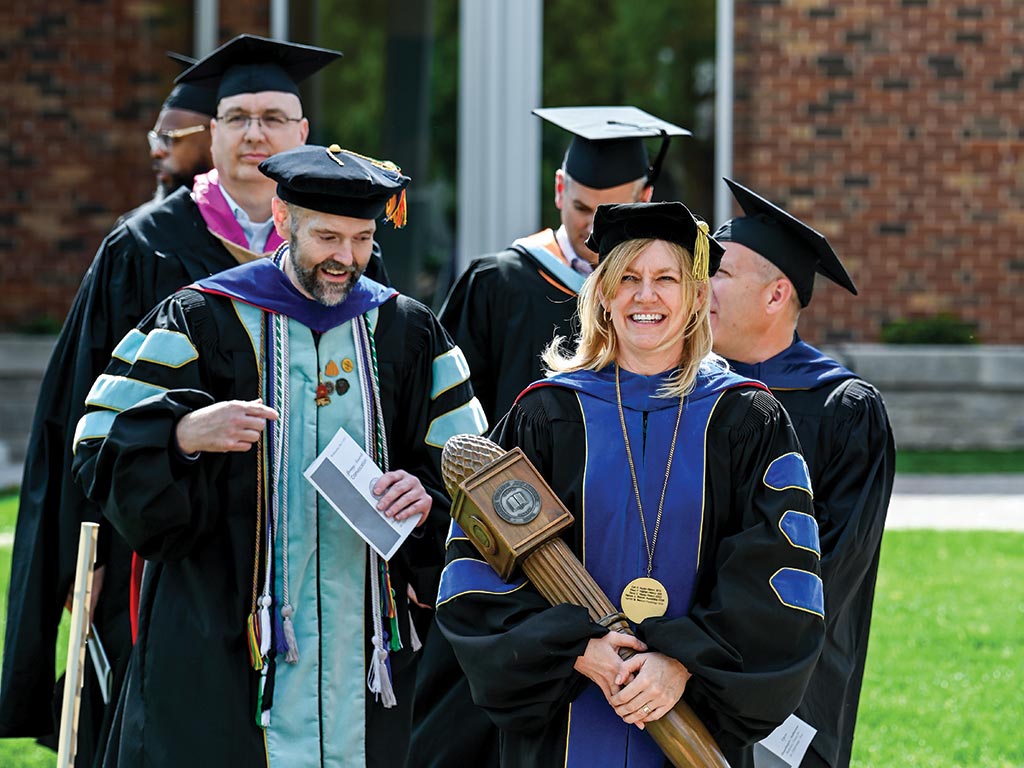
Above: The Centennial Mace is carried by Kathryn Westcott, faculty marshal, at the College’s opening convocation ceremony. It is also carried at Commencement.
Object
Carved from the Past, Carried Forward
The Centennial Mace carries Juniata’s history, heritage, and honor
By Tom Yencho
It may appear as an ornate staff of wood adorned with bronze. But in reality, Juniata’s Centennial Mace is a time capsule, a collection of several origin stories tying the college to Huntingdon and its earliest communal roots.
Crafted in 1975 for Juniata’s centennial and the invocation of President Frederick M. Binder, the mace was carved from beams of the James Creek Church of the Brethren — home to the College’s founders — before the church was razed to make room for Raystown Lake. Its bronze crown bears four medallions, each reflecting the story of Juniata: the college seal, affirming academic purpose; the Church of the Brethren’s 250th anniversary crest, honoring the religious community that founded Juniata; an image of Founders Tower, the historical heart of campus since 1879; and Huntingdon’s Standing Stone, a local landmark and memorial to the Native Americans who once inhabited the region.
Maces trace their origins to the ancient Near East and were carried by guards to protect royalty in medieval England. After the University of St. Andrews adopted it in the 15th century, the first university to do so, the mace would soon become a ceremonial affirmation of tradition and independence. Even now, the mace signals that institutions are uniquely entrusted to guard the virtues of learning.
Today, the faculty marshal at Juniata has the honor of bearing the mace and carrying forward the layered meanings of tradition for the College community.

Mary White ’73 completed her term as Juniata’s first female board chair in August 2025.
Alumni Insight
Finding Her Place, Then and Now
Mary White ’73 reflects on friendship, leadership, and legacy
By Tom Yencho
It was only a fleeting moment, but the memories flooded back.
Watching the Academy Awards in the early ’90s, Mary White ’73 did a double take — there on stage was Bruce Davis ’65, her freshman-year professor. She grinned as she relived the experience. Long before he became executive director of the Academy of Motion Picture Arts and Sciences, Davis had taught Great Epochs of World Culture at Juniata.
“It was the best class I’ve ever had,” she recalls. Mary completed her tenure as the first female chair of the College’s Board of Trustees in August and continues to serve on the executive committee. “It taught me to think, not just find the right answer. I came in as a math-and-science kid, but that class rewired me. It made me a broader thinker.”
That lesson in the liberal arts unfolded in a much different time. Fifty years ago, there were 10-cent pizza slices, Colonial Bar cheesesteaks, and late-night milkshakes at Roy Rogers in State College. Mary softly laughed as she remembered the red velvet chairs at the Red Fox Lounge at the Holiday Inn Junior, a popular stop for visiting parents.
“It was remote, sure,” she says, “but that was the beauty. With fewer distractions, you threw yourself into campus life, and you found your place.” For Mary, that meant lifelong friendships. She had the same roommate, Anne, all four years. She still texts her suitemates nearly every week.
It also meant charting her own academic path. Mary’s father was a doctor, her mother a nurse, and Mary assumed she’d follow a similar track. But when Juniata didn’t yet have a nursing program, she built a Program of Emphasis in medical technology. “That flexibility set me up for everything I’ve done since.” Today, she is vice president of resource management at HCA/HealthOne in Denver.
“The times change, the pace quickens — but the gift is still the same.”