
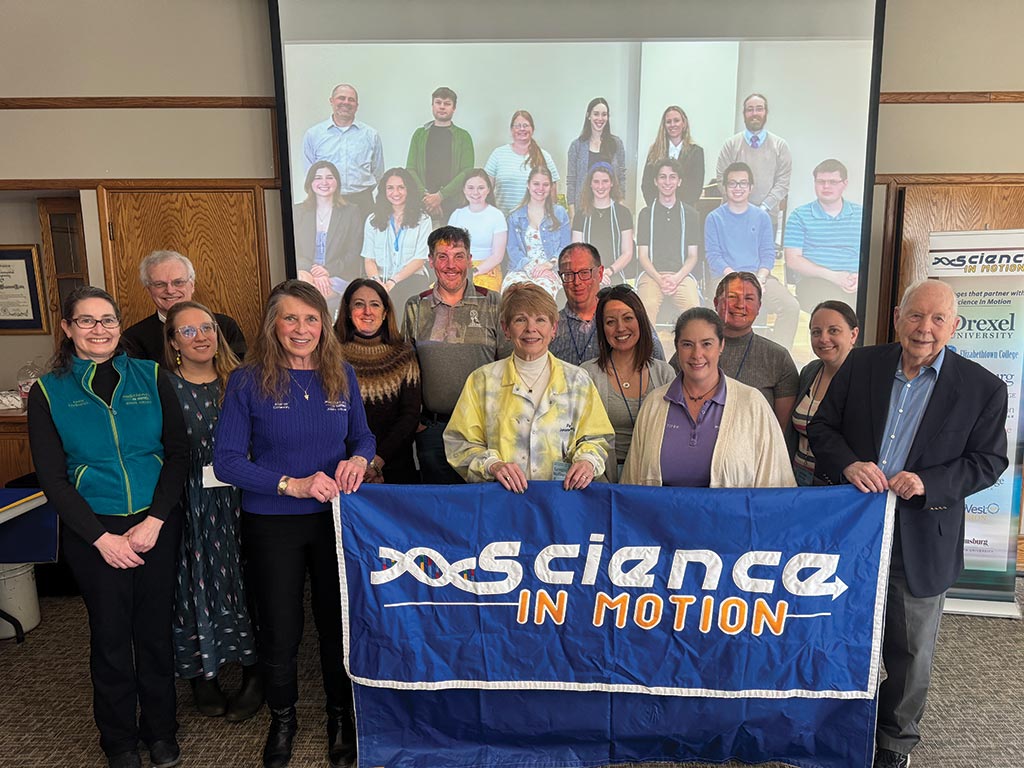
During the celebration of the 100th anniversary of Juniata's Chemistry Department in March, past and present Science in Motion personnel were honored.
Programs engage students with interactive, real-world learning
Across rural Pennsylvania, gymnasiums transform into planetariums, classrooms become chemistry labs, and students explore the mysteries of the natural world with hands-on experiments. This is the power of Science in Motion (SIM), a program born at Juniata College.
Donald Mitchell, professor emeritus of chemistry, had taught at Juniata for two decades when he recognized the challenges facing science educators in rural regions like Central Pennsylvania.
“When I visited high school chemistry labs, I realized nothing had changed in 25 years. Budgets were tiny, equipment was outdated or nonfunctional, and teachers had few chances to collaborate or explore modern science. Students weren’t getting the opportunities they needed to do 21st-century science,” he said.
Mitchell, while identifying barriers, also recognized the curiosity and drive thriving in local classrooms. In 1986, he and colleagues Kenneth Rockwell ’57, James Gooch, and Thomas Woodrow ’58 pursued — and were awarded — a $530,000 grant from the National Science Foundation (NSF) to launch SIM.
Officially launched in 1987, the program provided professional scientific equipment, mobile instructors, and continuing education for middle and high school teachers across Juniata’s home region.
The groundbreaking outreach initiative made national news, with Mitchell interviewed by Peter Jennings for ABC Nightline, inspiring an expansion into a statewide consortium of SIM programs hosted by several Pennsylvania colleges and universities. Similar efforts later emerged in Alabama, Delaware, California, Illinois, North Carolina, Ohio, and Virginia.
Today, Leslie Leckvarcik directs SIM, carrying forward Mitchell’s passion for rural science education. “Many high school chemistry departments lacked sufficient glassware or instrumentation to teach chemistry at the level they should have,” she said.
“When I was in ninth grade, the Starlab came to our school. The inflatable planetarium in the gym brought the stars almost within reach. Every time I run the Starlab now, the kids ooh and ahh as soon as the lights go out. They try to name the constellations — it never fails.”Kelsi Newman, SIM outreach coordinator
SIM now serves a six-county region covering roughly 3,000 square miles of rural Appalachia, bringing mobile science educators, equipment, and supplies to 29 schools and 14,523 students. The program supports chemistry, biology, physics, and middle school integrated science.
For many students, this is their first exposure to college-level science equipment. Kelsi Newman, SIM outreach coordinator, first encountered the program at Southern Huntingdon County High School.
“When I was in ninth grade, the Starlab came to our school,” Newman recalled. “The inflatable planetarium in the gym brought the stars almost within reach. Every time I run the Starlab now, the kids ooh and ahh as soon as the lights go out. They try to name the constellations — it never fails.”
Experiments with liquid nitrogen turn marshmallows into flash-frozen treats, microscopes reveal the natural world, and science comes alive in ways textbooks can’t replicate.
Each semester, about 15 Juniata students are employed by SIM to work in the laboratory adjacent to campus and prepare all the equipment and supplies needed for instructors to use in the classroom. Recipients of the Robert Noyce Teacher Scholarship Program of the NSF, awarded to the College in 2016 and 2023, also have additional classroom engagement opportunities with students through SIM.
“For Juniata students, working with Science in Motion requires students to step beyond theory and consider how their knowledge functions in practice,” explained Provost Lauren Bowen.
That process, she noted, is at the heart of experiential education. It requires students to break down complex concepts, adjust methods, engage younger learners, and apply what they've learned in class.
True to Mitchell’s vision, SIM continues to access standards-aligned, hands-on activities. This is particularly important as school districts implement STEELS (Science, Technology, Engineering, and Environmental Literacy Sta-ndards), shifting k–12 curricula from lecture-based instruction to project-driven learning. Implemented in high schools in the 2025–2026 academic year, middle and elementary schools are preparing to follow.
“SIM’s support helps teachers adopt the STEELS approach,” Leckvarcik noted. “Some are excited; some are hesitant because it’s a new method that demands more classroom management. Our resources make that transition smoother.”
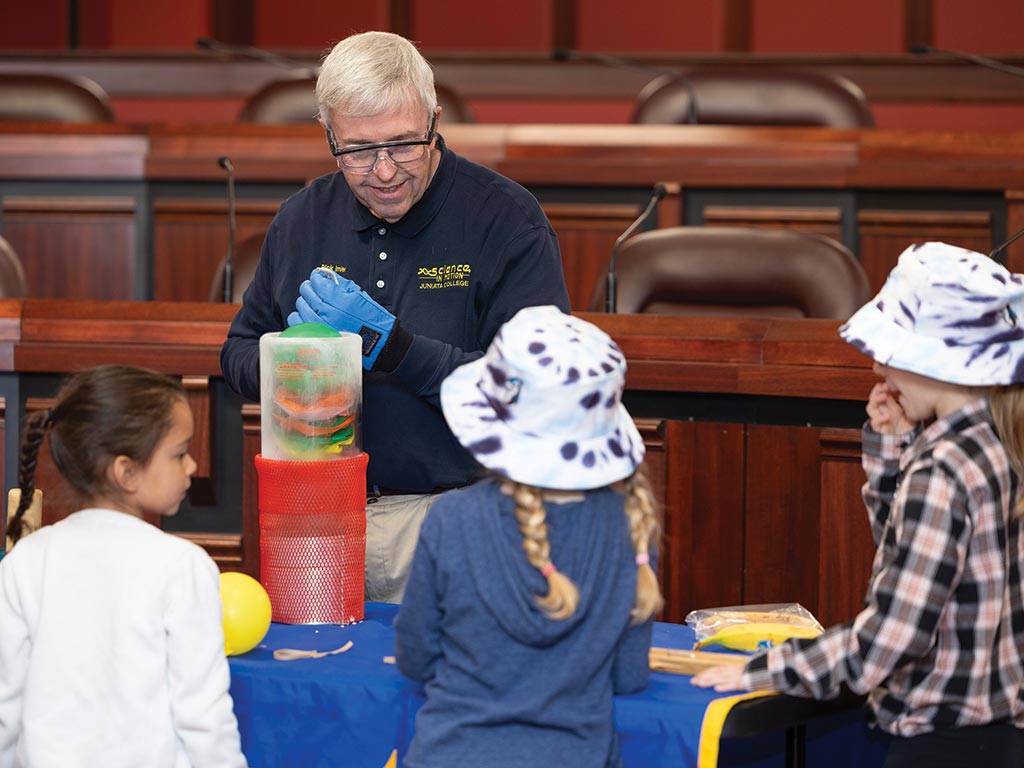
Above: Rick Imler, Science in Motion chemistry instructor, leads an experiment for local students.
The statewide SIM Consortium now includes 10 members, with programs at Commonwealth University-Bloomsburg, Drexel University, Elizabethtown College, Gettysburg College, Lehigh Carbon Community College, Penn West University-Clarion, Ursinus College, Westminster College, Wilkes University, and Juniata. Collectively, the consortium served 714 teachers with 956 labs, creating 179,047 student experiences in 2024–2025.
The program’s contributions do not go unnoticed. “As our world becomes increasingly technology-driven and dominates every aspect of our lives, critical thinking and problem-solving skills are more essential than ever,” said Senator Judy Ward. “STEM education, through programs like Science in Motion, exposes young students to hands-on experiences that encourage curiosity and innovation and introduce them to future career opportunities,” she added.
“In my position as State Representative, I have always offered my full support to the Science in Motion program at Juniata College,” said Representative Rich Irvin. “It has been and continues to be very effective in our local schools by not only sparking interest in STEM education but providing access to the latest research and advanced tools for our students and educators.”
Since its original NSF grant, SIM has relied on federal, state, and private support, including the Pennsylvania Department of Education, the Pennsylvania Regional Junior Science and Humanities Symposium, and the NSF Robert Noyce Teaching Scholarship.
“SIM is a powerful example of how Juniata’s innovative and deeply committed faculty turn classroom learning into meaningful action that benefits students across Pennsylvania,” said Jim Watt, vice president for advancement and new strategic initiatives. “What makes this program truly special is that it's an act of service. That kind of work isn’t easy — it requires dedication and heart.”
He added, “We’re incredibly grateful to our public and private partners who help make this program possible year after year. Whether or not those kids we help end up at Juniata, every student deserves access to inspiring, hands-on science education — and we’re proud to play a role in making that happen.”

Above: Through LIM, Juniata College students bring languages and cultures to life for k–12 classrooms across the region.
Global Voices in Local Classrooms
When a classroom lights up with the sounds of Spanish, the rhythms of Russian music, or the lively chatter of French, students don’t just learn words — they travel the world without leaving their desks. Through Language in Motion (LIM), Juniata College students, international students, study-abroad returnees, and heritage speakers bring languages and cultures to life for k–12 classrooms across the region.
“Language in Motion brings the world to our region,” said Provost Lauren Bowen. She noted that the program fosters cultural understanding for both Juniata students and local k–12 students. “There is a tremendous benefit for our students when they have the opportunity to share their experiences with others. And I think their audiences are enriched by the presentations. We pride ourselves on our demonstrable excellence in experiential education and giving our students the opportunity to put theory into practice. Telling stories and sharing cultural traditions off campus is a powerful way to give that meaning; you see that happen in Language in Motion.”
The program’s inspiration came in early 2000, when JoAnn deArmas Wallace, then dean of International Programs, walked past the Science in Motion vans and wondered whether a similar approach could be applied to language and culture. With funding secured, Deb Roney, now assistant professor emerita of English, was hired as the first director.
“The first semester, we had 13 students and eight teachers. We went to four schools, chosen intentionally because they taught French, German, Russian, or Spanish,” Roney recalled. “Everybody loved it.” She added that teachers were vital partners from the start: “We held coffee and donut meetings before the beginning of the first semester, and we kept the conversation going.”
As word spread, more Juniata students and local educators joined, and presentations expanded beyond language instruction to include cultural content. Support from the Arthur Vining Davis Foundations from 2004 to 2010 allowed LIM to grow into a nationwide consortium with 22 participating colleges and universities at its peak.
At Juniata, students prepare for presentations with a five-part workshop series on communication and educational concepts, even though most are not planning careers in teaching.
“Everyone thinks about the benefits for the students we’re presenting to, but our Juniata students get a lot out of it too,” said Jessica Martin, who became director of LIM after Roney’s retirement. “Study abroad returnees gain a chance to reflect on their experiences in a meaningful way. International students build confidence as they go out and present in English as non-native speakers. It’s a huge benefit all around.”
More than two decades and 8,000 Juniata presentations after its founding, LIM continues to thrive as a bridge between the College and the community and provides a lasting impact for participants.
Bowen emphasized the program’s impact on student growth as well as community connection. “For our students, it gives them an opportunity to reflect on their experiences and to hone their presentation skills. They reflect more deeply on what it means to study abroad and to be an international student. It cultivates cultural fluency and awareness and represents the best of what Juniata seeks to be.”